
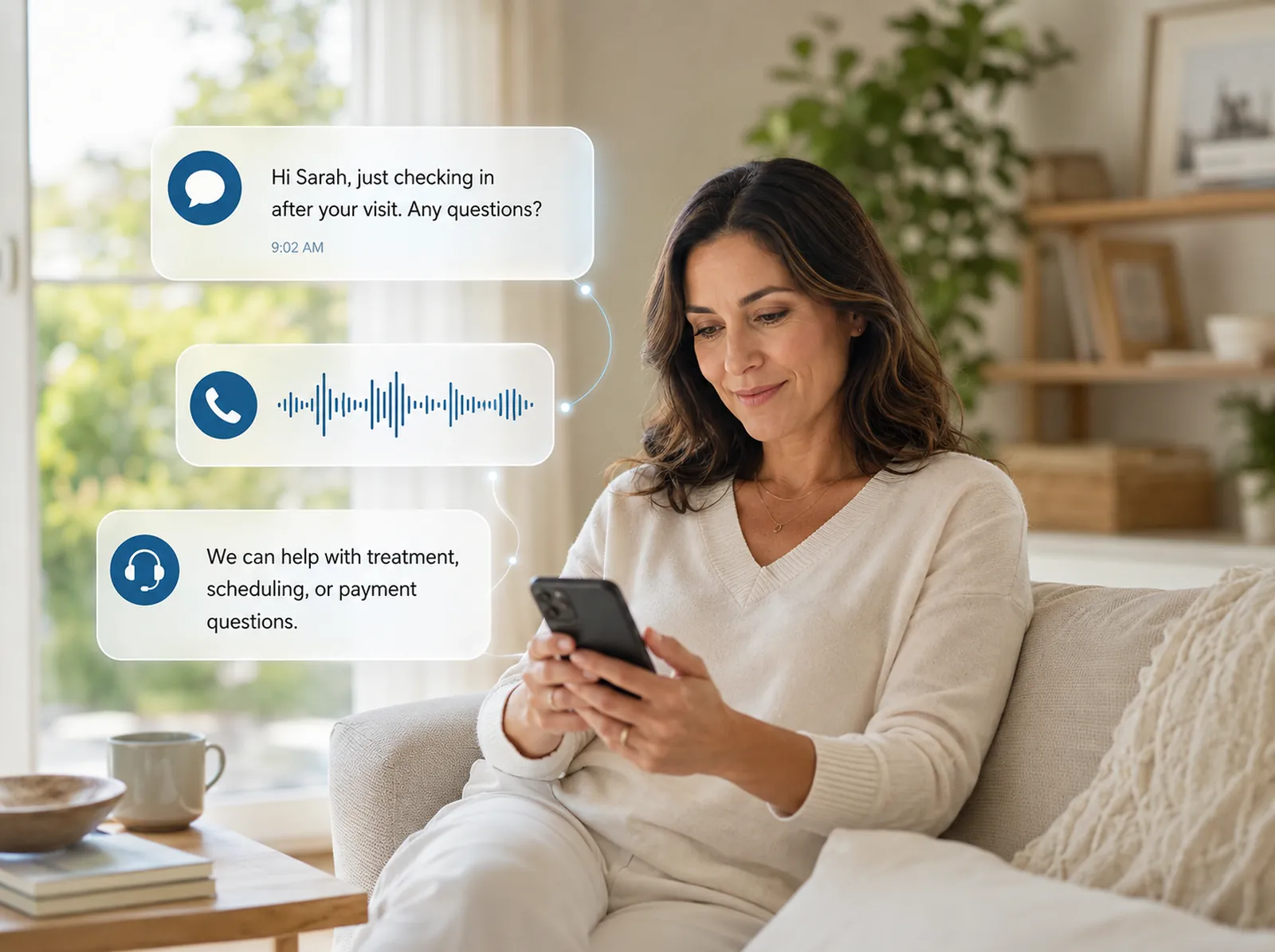
“I’ll think about it.”
Every dental practice knows this moment. The exam is done. The dentist has explained what they found. A treatment plan has been discussed, and the patient has had a chance to ask questions. Then they say: “Let me think about it.” They leave. Nothing dramatic happened, but nothing gets scheduled either.
And a long list of questions begins for the practice:
01Who should follow up: the dentist, the treatment coordinator, or the front desk?
02How soon should someone reach out?
03If the patient doesn’t answer, when do we try again?
04Should we text instead? What should the message say?
05What if the patient comes back with a question?
06What if they say, “Call me next month”?
And perhaps the hardest question of all
Who is going to remember all of this?
That is the real treatment-plan follow-up problem. Not sending a message, but keeping dozens of individual, half-finished conversations moving until each one reaches an answer.
“I’ll think about it” doesn’t always mean no
It helps to look at the situation from the patient’s side. They may have left the practice with several things on their mind:
“How much will this cost?”
“What does my insurance actually cover?”
“What will recovery look like?”
“Can I wait?”
The patient,
on the drive home
“How much time will I need away from work?”
“Should I talk to my spouse first?”
“What if I have another question for the dentist?”
Meanwhile, life keeps goingWorkFamilyErrandsTravel
Or maybe none of those things are stopping them. They simply went back to work, family, travel. Normal life. The treatment plan moved down the list. That does not mean every patient will eventually decide to proceed, and nor should they. A patient should always be free to say yes, no, not now, or I need more information. The money worry, in particular, is not imagined: the American Dental Association’s Health Policy Institute has consistently found cost to be a leading reason Americans delay or skip dental care.5
Then the practice’s reality takes over
From the outside, follow-up sounds simple: “call them in a few days.” Inside a busy practice, it is rarely that simple. The phone is ringing. Patients are checking in. Someone cancelled tomorrow morning. Insurance needs verification. Another patient needs a referral. A hygienist is waiting on something. And somewhere inside the practice management system sits a list of patients who left with unscheduled treatment. The strain is well documented: MGMA research on practice phone access has described clinics where more than half of incoming calls went to voicemail at peak times.6
The team absolutely means to follow up. But follow-up is competing with everything that needs attention right now. That is why practices often end up relying on someone simply remembering. Sarah needs a call after her vacation. Mike wanted to think about financing. Jessica had a question for Dr. Smith. Robert said to reach out after his insurance resets. Emily wanted afternoon appointments.
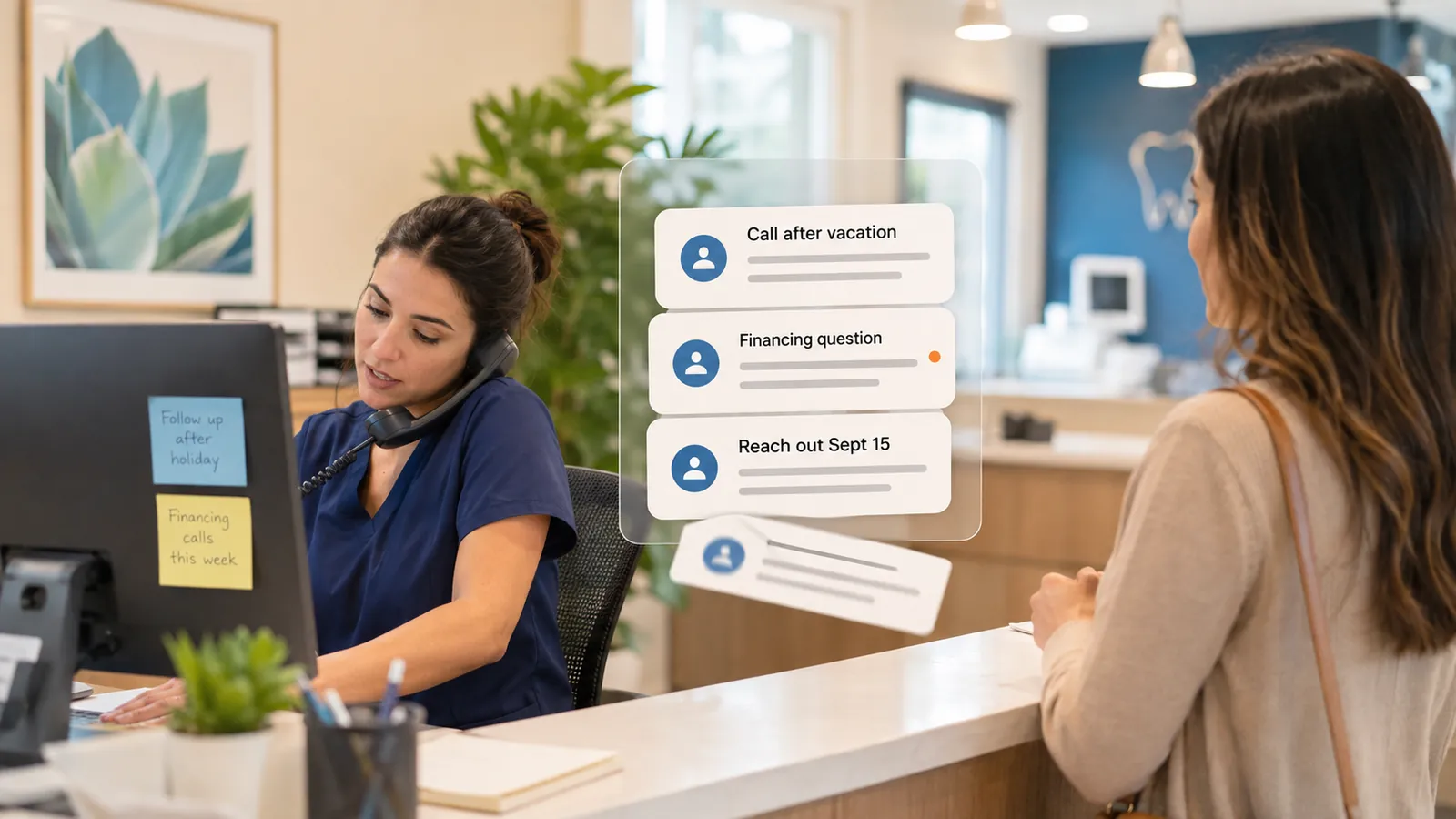
The real problem is continuity. The patient has questions. The practice has information. Both sides may still want the conversation to continue. But after the patient leaves, somebody has to keep that connection alive. Traditionally, that means lists, reminders, tasks, calls, texts, notes, and people remembering what happened last time. So practices automate what they can. Usually, that means reminders.
A reminder is not a conversation
A traditional automated follow-up looks like a sequence: treatment discussed, text, another text, another text. That can help with consistency, but it only solves one part of the problem: did we send something? It does not solve the more important question: what happens when the patient replies?
Imagine three patients who all leave without scheduling. One is worried about cost. One is trying to work out time away from work. One wants to ask the dentist another question before deciding. All three receive: “Hi, just checking whether you would like to schedule your treatment.” There is nothing wrong with the message. It simply does not address why each conversation stopped. Three different patients, three different situations, one identical reminder.
A reminder campaign
Day 3
Hi, just checking whether you would like to schedule your treatment.
Day 10
Hi, just checking whether you would like to schedule your treatment.
Day 17
Final reminder: would you like to schedule your treatment?
No reply. Sequence complete.
Three sends, zero listening. Sarah’s actual question never surfaces.
A conversation
Day 3
Hi Sarah, just checking in after your visit with Dr. Smith. If any questions came up while you were thinking things through, you can reply here and we’ll help.
Actually, yes. Can you remind me what payment options the office offers?
Of course. Here are the plans the practice offers, including monthly options. Want me to send the details, or find a time to talk them through?
Thanks! I’m travelling this month. Can we pick this up after Sept 15?
Noted: reconnect after Sept 15. Context saved for the team.
Sept 16
Welcome back, Sarah! Ready to look at times for that crown? Thursday afternoons are open.
The same channel, now two-way: the question gets answered, the timing gets remembered, and the thread picks up where it stopped, not from zero.
A reminder is one-way: the practice sends, and the patient stays silent. Real follow-up is two-way: the patient replies, and the reply decides what happens next.
Automation sends the next message. An agent can manage the next step.
This is where AI changes what is possible, and not because AI can send more messages. Software has been able to do that for years. The interesting change is that an AI follow-up agent can participate in a two-way conversation, remember what happened, take the appropriate next action, and involve someone from the practice when it needs help.
Stop asking“How do we automate our follow-up messages?”
Start asking“How do we keep an unfinished patient conversation moving, without anyone manually managing every step?”
What an AI follow-up agent can actually do
A good AI follow-up agent works more like an extension of the practice than a reminder campaign. Here is the shape of it:
Act 1 · Opening the door
Starts with context
Which patient, which visit, what was discussed, when to reconnect.
Reopens the door naturally
“If any questions came up, you can reply here,” not “ready to book?”
Act 2 · When the patient replies
Listens to the reply
A question, a timing request, a yes, a no. Each creates a different next step.
Handles the routine
Availability, hours, forms, practice-approved financing information.
Knows when to ask
Clinical questions go to the care team, with the conversation attached.
Act 3 · Keeping it moving
Moves across text and voice
Different interactions, one continuing conversation.
Remembers what happens later
“Reach out after September 15” becomes part of the workflow, not a sticky note.
Takes action, not just answers
Schedules, routes, escalates, reconnects.
It starts with context
A patient should not feel as though every interaction starts from zero. When the relevant information has been captured by the practice and made available to the workflow, the agent can work from context such as which patient it is speaking with, which visit the follow-up relates to, what the patient said previously, their communication preference, and the information the practice has approved it to provide. The agent remembers so the front desk doesn’t have to.
It reopens the door instead of pushing for a booking
The first message does not have to say “Are you ready to book?” It can simply say: “Hi Sarah, just checking in after your visit with Dr. Smith. If any questions came up while you were thinking things through, you can reply here and we’ll help.” The practice is not saying “please buy this treatment.” It is saying “you can still talk to us.” And Sarah might reply about payment options, about travel, about one more question for Dr. Smith, or with “I’m ready, do you have anything Thursday?” Each answer creates a different next step. The agent is no longer simply sending messages. It is listening to what happens next.
It doesn’t need to know everything. It needs to know when to ask.
This is particularly important in healthcare. An AI follow-up agent is not the dentist. It should not independently diagnose a condition, change a treatment plan, interpret a new symptom, or create patient-specific clinical advice. Suppose Sarah says: “Before I schedule, I want to know whether there is another treatment option.” The agent should not invent an answer. It should recognize: this question needs the care team, and send it to the appropriate person with the relevant conversation attached. The dentist or treatment coordinator responds, and the patient receives that response as part of the same ongoing conversation. No calling again. No explaining everything from the beginning. No one manually moving information between five different places. That division is not just design taste: a peer-reviewed JMIR review of conversational agents in healthcare concluded that hybrid systems supporting care teams are more sustainable than tools that operate apart from humans,8 and the AMA finds physicians see administrative work, not clinical judgment, as AI’s most practical use.7
AI handles
- Continuity and outreach timing
- Routine administrative questions
- Remembering future follow-ups
- Scheduling help when the patient is ready
Humans handle
- Care and clinical judgment
- Changes to the treatment plan
- New symptoms and concerns
- Empathy and exceptions
It acts on what the patient says
This is one of the biggest differences between a chatbot and an agent. A chatbot primarily answers. An agent helps move the workflow forward across text and voice, since patients do not all communicate the same way. Some prefer texting; some want to talk; some reply at 9 PM when the practice is closed; some start with a text and later want a call. Different interactions, one continuing conversation:
“Please call me after the 15th.”
The agent remembers the request and schedules the future follow-up
“I’d rather talk about this.”
The conversation moves toward an appropriate call workflow
“I have a clinical question.”
The right person from the practice joins, with the context attached
“I’m ready to schedule.”
The conversation moves into the practice’s approved scheduling workflow
What this can look like for one patient
Consider one complete journey: the same Sarah from the thread above, seen from the practice’s side:
Day 1: the visit
Treatment discussed; Sarah leaves without scheduling. The conversation stays open.
Day 3: check-in
“If any questions came up, you can reply here and we’ll help.”
The reply
“I’m worried about recovery time,” routed to the care team with context
The answer
Sarah gets the team’s response in the same thread, then asks to reconnect after Sept 15
The pause
The agent remembers. Not before. Not three months late.
Sept 16: booked
The agent reconnects; Sarah picks Thursday afternoon
One patient. Several weeks. Text, human input, potentially voice, and scheduling. One continuing conversation. That is much more than a reminder sequence.
A good follow-up does not always end in a booking
This is worth saying clearly: the goal of follow-up is not to convince every patient to accept treatment. Every outcome below beats silence, because every one of them is a clear next step:
All of these count as follow-up working
How should a dental practice evaluate an AI follow-up agent?
As more AI follow-up tools become available, practice owners should look beyond whether a product can “send automated texts.” A useful follow-up agent should be able to answer much more important questions:
| Ask the vendor | Why it matters |
|---|---|
| Does it remember the conversation? | Context should carry across interactions, not restart with every message |
| Can patients reply naturally? | A real two-way conversation, or just a smarter reminder sequence? |
| Can it work across text and voice? | Patients shouldn’t have to communicate according to the software’s limitations |
| Does context move between channels? | A text and a later call should be understood as the same conversation |
| Can it bring a human in? | Clinical questions, sensitive situations and exceptions need a clear handoff path |
| Can it remember future actions? | “Contact me next month” has to actually happen next month |
| Can it act on what the patient says? | Scheduling, next steps and connections to the practice’s other systems, not just answers |
| Does the practice control what it can say? | Healthcare AI should work inside workflows, information and boundaries the practice defines |
| Can the practice see what happened? | Every conversation, action and escalation should be reviewable, including which patients still need human attention |
| Is it designed for healthcare? | Patient information, consent, preferences and escalation built into the design, not added as an afterthought |
Those are the questions that matter much more than “Can your AI make phone calls?”
Treatment-plan follow-up is also only one example. Practices have many conversations that can quietly become unfinished, and they need different timing, language, context and rules around when a human should be involved:
| Situation | What the next conversation may need |
|---|---|
| Unscheduled treatment | Answer questions and reach a clear next step |
| Recall / recare | Help the patient return to the right schedule |
| Cancellation | Make rescheduling easier |
| No-show | Reconnect and find the appropriate next step |
| Post-treatment check-in | Follow practice-approved protocols and escalate concerns |
| New-patient inquiry | Continue an inquiry that never became an appointment |
That is why follow-up makes more sense as part of the practice’s operational system than as another generic marketing campaign.
Healthcare follow-up needs clear boundaries
AI can make patient communication much easier, but healthcare cannot be treated like ordinary sales automation. Five principles matter most:
Protect patient information
1 / 5A message doesn’t need clinical detail to reopen a conversation.
Patient-specific context should only be available where it is appropriate for the workflow. That is HIPAA’s minimum-necessary principle in practice.2 Often, “checking in after your recent visit” is enough, and HHS guidance on patient messages points the same way.4
In practiceKeep unnecessary clinical detail out of texts, notifications, or calls.
Keep clinical judgment with the care team
2 / 5When judgment is required, the right action is escalation.
AI should not independently diagnose patients or change clinical recommendations. When a question needs the dentist, the agent’s job is to bring the dentist in, with the conversation attached.
In practiceThe agent recognizes what it should not answer.
Respect preferences and opt-outs
3 / 5Patients control how, and whether, they’re contacted.
Beyond HIPAA, automated calls and texts fall under federal and state communication rules. Consent, communication preferences and opt-outs all matter.3
In practiceIf a patient says stop, everything stops.
Be transparent
4 / 5Patients should know when they’re talking to an assistant.
AI should make communication easier. It should not pretend to be a person. A simple introduction from the practice’s assistant keeps the interaction natural and honest.
In practiceThe assistant introduces itself as one.
Use technology designed for healthcare
5 / 5Security and compliance built in, not bolted on.
When protected patient information is involved, practices need appropriate security controls, agreements, access controls and workflows designed around healthcare requirements.1 At Glace, a Business Associate Agreement is put in place before Glace handles PHI for a practice.
In practiceAsk any vendor for the BAA before the integration, not after.
Where Glace fits
At Glace, we think about these conversations as different moments in one patient journey. A patient may search, discover the practice, learn, call, visit, receive a treatment plan, go home, ask another question, and schedule. Today, every arrow can become a place where communication breaks. We are trying to connect those moments:
Search
Patient looks for care
Discover
Finds and checks the practice
Visit
Consult and treatment plan
Home
Questions surface later
Follow-up
The conversation continues
Schedule
The next step gets booked
Before they reach you
Marketing & AI Visibility
Patient education content, healthcare SEO and call-first ads that generate inquiries, plus whether Google and AI assistants recommend you when patients ask
When they reach out
AI Front Desk
The conversation is answered and can move toward an appointment
When the conversation pauses
AI Follow-Up
The line stays open, listening, remembering, and bringing the team in when needed, until there is a clear next step
The bigger opportunity is an always-open conversation
Practices already have software that sends reminders. That is not the interesting part. The more interesting possibility is this: what if patients always had an appropriate way to continue a conversation with their practice? Not a generic chatbot that knows nothing about why they visited. Not an endless sequence asking them to schedule. Not an AI pretending to be their dentist. A communication layer that understands the workflow it has been given: one that remembers, listens, follows up, knows when to ask for help, brings the right person into the conversation, and helps complete the next step.
For the patient, that means fewer unanswered questions and less friction. For the practice, it means fewer conversations depending entirely on someone remembering to make another call. And when the patient is ready to continue, they do not have to begin again from the start.
Sometimes, the patient hasn’t said no. The conversation simply stopped. AI can help make sure there is always a way for it to continue.