
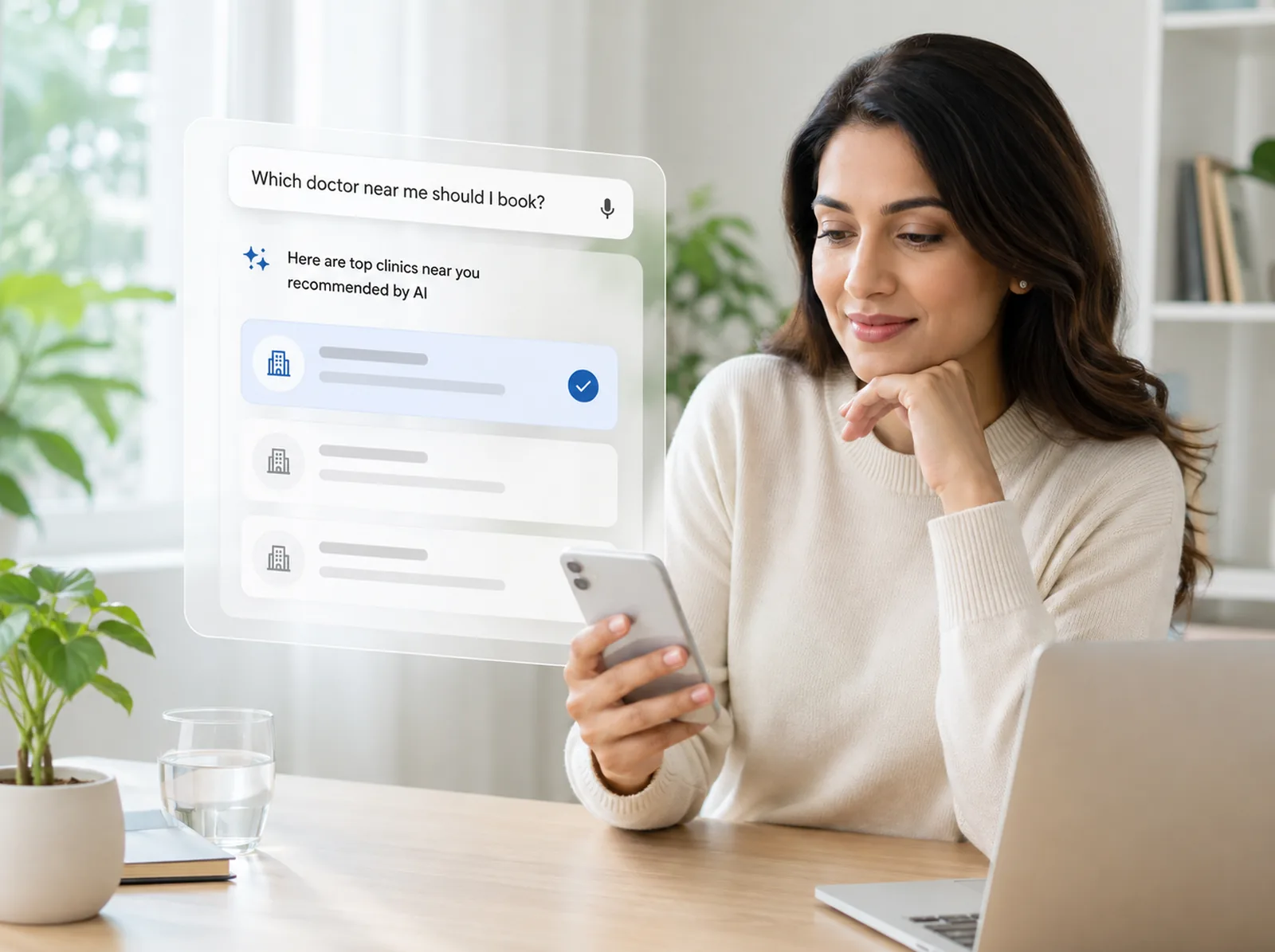
For twenty years, "being found" meant one thing: rank on the first page of Google. That contract is changing. ChatGPT answers questions with live web search behind them, Google composes AI answers above its classic results, and Perplexity builds cited summaries instead of link lists.5, 2 Claude, Copilot and voice assistants follow the same pattern, and the AI agents that will soon call and book on a patient's behalf lean on the same answer layer. The patient journey that used to end in a list of ten links increasingly ends in a paragraph that names two or three practices by name.
Patients now ask AI who to see
The questions patients type into an AI assistant are not keywords. They are situations:
Insured, and in a hurry
"Dermatologist near me who takes Blue Cross and has appointments this week"
A worried parent
"Best pediatric dentist in San Jose for an anxious 6-year-old"
Starting from a symptom
"I have heel pain in the morning. What kind of doctor should I see, and who is good near Fremont?"
An AI assistant explains the condition, tells the patient which kind of provider to see, and then names specific practices it considers a good fit. That last step is the part that matters commercially. The patient never sees a results page. They see a recommendation.
This behavior does not replace classic search; it layers on top of it. Google's own guidance is explicit that AI features in Search build on the same foundations as ranking has always used.1 But the surface the patient experiences is different, and a practice can be adequate at classic SEO while being entirely absent from the AI layer. Whichever assistant or agent a patient uses, the practices it recommends are the ones that get the appointment.
The shortlist is the new first page
A classic results page distributes attention: ten organic links, a map pack, ads. Patients triage it themselves, and even position eight gets some clicks. An AI answer does the triage for the patient. In the visibility scans Glace runs for practices, answers to "who should I book" questions typically name only a small handful of local practices, often two to four, and describe why each was chosen.
What patients used to see
SponsoredSkin & Laser Center · Book a Consultation Today
10 Best Dermatologists in San Jose, CAhealthgrades.com
THE BEST Dermatologists Near Me (Updated 2026)yelp.com
Find In-Network Dermatologists, Book Onlinezocdoc.com
San Jose Dermatology & Skin Care Clinica practice's own site, sitting at position 7
…and six more links. The patient opens tabs, compares, decides.
Ten links and a map. The patient does the sorting, and even #8 gets seen.
What they see now
"Which dermatologist near me takes Blue Cross and can see me this week?"
Based on insurance, availability and patient reviews, here are the practices I'd recommend:
That is the whole answer. Every other practice in town is invisible.
Two to four practices, named with reasons. The sorting is already done.
That compression changes the economics. If the assistant recommends the practice across town, your practice did not rank lower; it was never in the conversation. And the cost of "never in the conversation" is not an SEO metric; it shows up in the numbers you already watch.
Run the owner's math. A patient who books from an AI recommendation costs you nothing to acquire; the same patient reached through ads costs real money, so every recommendation you miss quietly raises your average cost per new patient, because paid channels have to make up the gap. The slots those patients would have filled sit empty while the recommended competitor's schedule tightens. And the effect compounds: the practice getting named books more patients, collects fresher reviews, and becomes even easier for the next answer to justify. The practices on the shortlist are not necessarily better than yours; they are more legible to the systems doing the choosing. The gap is fixable, but every month it stays open, it widens.
How AI decides who to recommend
AI systems do not "browse" the way a patient does. When a question needs current, local facts, they retrieve from search indexes, crawled pages, business listings and review data, then compose an answer from what they can find and verify.2, 5 Five kinds of signals decide whether your practice makes it into the answer, and they build on each other:
Crawlable, indexed, snippet-eligible
1 / 5If AI can't read your site, you don't exist.
Google only uses pages that are in its index and allowed to show a preview1, 2, and ChatGPT needs its crawler, OAI-SearchBot, let in.5 Content that only appears after the browser runs code is invisible to both.
FixAsk your web person: can Google and ChatGPT read every page on our site?
Consistent practice data
2 / 5One wrong address can quietly drop you from answers.
Hours, insurance, languages, new-patient status: keep them identical on your site, your Google Business Profile1, 4, and the directories answers cite, like Healthgrades, Zocdoc and WebMD.
FixMake your five biggest listings match your website, word for word.
Reviews, treated as evidence
3 / 5AI quotes your reviews back to patients.
"Great with anxious kids," "short waits": the themes, volume and freshness of your reviews become the reasons an answer gives for recommending you.
FixKeep fresh reviews coming monthly and reply to repeat complaints.
Content that answers the fan-out
4 / 5One patient question becomes many small searches.
Google calls it "query fan-out"2: insurance, availability and location get looked up separately, and the pages that answer those small questions are the ones that get used.1
FixPick the question you most want to win and give it its own page.3
Authority: earned, not manufactured
5 / 5Trust builds slowly, and there is no shortcut.
Hospital affiliations, professional associations and local press prove you are real and reputable; Google says outright that manufactured mentions count as spam.1
FixChase real mentions: your hospital affiliation, your association, a story in the local paper.
How to check where you stand
The manual version costs nothing: write down five to ten questions your patients would realistically ask, including your specialty, your city and your insurance networks, and put them to ChatGPT, Gemini, Perplexity, and whichever other assistants your patients use. Note which practices get named. Most owners who do this for the first time discover two things quickly: their practice appears far less often than they assumed, and the same one or two competitors keep showing up.
The manual version also has limits. Answers vary with phrasing, location and the day you ask; a single spot-check can reassure or alarm you for the wrong reasons. Measurement needs repetition across many question variants, which is tedious by hand and cheap to automate. That is exactly what the free report just below does.
A starter set of questions to test
If you want to run the manual check today, adapt these eight templates to your practice: replace the bracketed parts and keep the phrasing conversational, the way patients actually type:
| Ask this | What it reveals |
|---|---|
| "Best [specialty] in [city] for [common condition you treat]" | Whether you appear for your core service |
| "[Specialty] near [neighborhood] that takes [your largest insurance network]" | Whether AI knows your insurance networks |
| "Who is a good [specialty] in [city] that's accepting new patients?" | Whether your availability is visible |
| "[Symptom a patient would describe]. What kind of doctor should I see near [city], and who do you recommend?" | Whether you surface from symptom-first questions |
| "[Specialty] in [city] with same-week appointments" | Whether access speed works in your favor |
| "Is [your practice name] good? What do patients say?" | How AI distills your reviews when asked directly |
| "[Your practice name] vs [competitor patients compare you to]" | How you're framed head-to-head |
| "[Specialty] in [city] that's good with [anxious kids / elderly patients / first visits]" | Whether your differentiator has reached the answer layer |
The first five rows measure whether you appear at all. The next two show how AI describes you when asked directly, often a distillation of your reviews. Run the set across at least two assistants, save the answers, and repeat with the same wording next month. That consistency is what makes the numbers comparable.
Run your free report right here
Free: live ChatGPT and Gemini answers, your mention rate, and your share of voice against named competitors. In your inbox in about five minutes. No login, no sales call.
Scanning the AI landscape for you…
Asking ChatGPT what patients in your city hear…
Takes about five minutes: these are real, live AI answers, not a simulation. Your report goes to the moment it's ready, so you can close this page.
Your report is in your inbox.
Sent to
It comes from hello@glace.sh. If it's not in your inbox within a couple of minutes, check spam or promotions.
Want us to walk you through it? Book a free call and we'll turn the findings into a plan.
Taking a little longer than usual.
Your scan is still running. We'll email the finished report to the moment it's ready. No need to keep this page open.
It comes from hello@glace.sh; give it a few more minutes and check spam if needed.
How the Glace check measures it
Transparency matters here, because most tools selling "AI visibility" are black boxes, a dashboard with a score and no way to validate it. So here is the Glace method, in full: the check starts from hundreds of possible patient-question combinations, curates the set that fits your specialty and your city (a typical scan asks around sixty of them, the questions you should be getting recommended for), and puts each one to live ChatGPT and Gemini: real answers with web search enabled, not simulations. Each question runs multiple times, because AI answers vary run to run, and single samples mislead. Every answer is parsed for which practices it names: your mention rate is how often you appear, and your share of voice is your slice of all mentions versus the competitors the answers actually name. The report arrives by email with a share-of-voice leaderboard and a prioritized fix list. Whatever tool you use, ours or anyone's: if the vendor will not tell you how they measure, ask why.
However you measure, by hand or with a tool, the point is to turn "are we visible in AI search?" from a feeling into a number you can re-check on a schedule and move deliberately.
What matters specifically in the U.S.
For American practices, three details carry outsized weight in AI answers because they carry outsized weight in patient questions:
| Signal | Why it decides U.S. answers | Where to state it |
|---|---|---|
| Insurance networks | "Takes Aetna" appears in a large share of realistic U.S. patient questions; plans locked in a PDF or a phone call are invisible to answer engines | Crawlable text on your site, kept current |
| Accepting new patients | Assistants prefer recommendations that can be acted on; this maps directly onto the question patients ask most | Your site and your Google Business Profile |
| Directory presence | U.S. provider answers frequently cite established healthcare directories alongside practice websites; contradictions there undermine you | Claimed, accurate profiles on the directories for your specialty |
None of this is exotic. The practices that AI recommends are, overwhelmingly, the practices that made themselves easy to verify. That is good news: it means AI visibility is not a new discipline to master but a stricter grader of the fundamentals you already know. And unlike a results page, it tells you exactly who is winning instead of you.
Want the baseline without the manual work? Run the free Glace AI visibility check and get your mention rate, your share of voice against named competitors, and a prioritized fix list in your inbox.