
The finding that started this article
We recently came across something interesting while generating an AI visibility report for a dental practice.
The practice was being recommended in several answers from AI assistants. At the same time, parts of its website were not reliably accessible through the retrieval methods we were testing.
That raised an obvious question: if AI is having trouble accessing the website, how is it recommending the practice at all?
We looked deeper into the answers and the sources behind them. The explanation was simple: AI was not relying only on the practice's website. A lot of the supporting information was coming from third-party websites, business listings, reviews, and other sources across the web.
That changed the way we think about AI visibility, and it is the reason this article exists.
Your website is only one part of your AI visibility
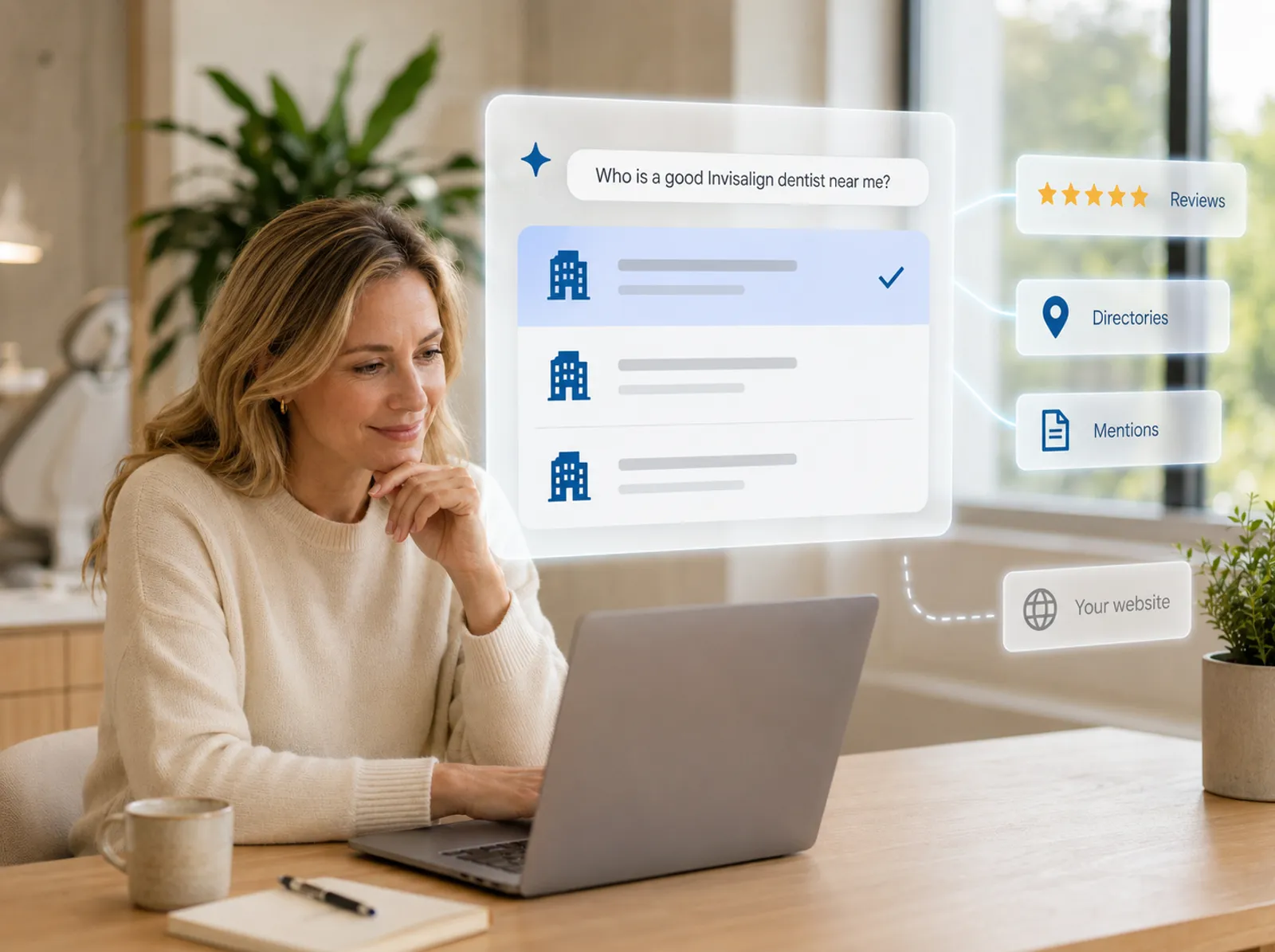
When someone asks ChatGPT, Gemini, or another AI assistant for a recommendation, the system may have access to information about a business from many different places:
Your website
Potentially the richest source, if machines can read it
Business profiles
Google and local listings: hours, location, services, photos
Reviews
Ratings, and the words inside them
Industry directories
Profiles on trusted platforms in your category
Articles and mentions
Third-party pages that talk about you
Other indexed pages
Anything else search systems have already read
For a dental practice, strong ratings, a consistent business presence, and mentions across trusted directories may be enough for an AI assistant to understand: this is a well-reviewed dental practice in this city.
But that does not necessarily mean the practice will be recommended when someone asks: who is a good Invisalign dentist near me? That requires a more specific set of signals, and we will come back to it below.
Reviews are not just reputation. They are information.
This was one of the most interesting things we noticed.
Businesses usually think about reviews as social proof. A prospective patient sees a 4.9-star rating and feels more confident calling the practice. That still matters.4 But reviews also contain information that reinforces what a business is known for.
Consider the difference between these two genuine, positive reviews:
A review as reputation
Five stars
"Great dentist. Highly recommend."
Positive, and appreciated. But it teaches AI nothing about what the practice does.
A rating without substance raises the score, and nothing else.
A review as information
Five stars
"Dr. Smith made my Invisalign treatment easy and explained every step clearly."
What a machine can connect: Invisalign + Dr. Smith + patient experience + this practice.
The same five stars, now carrying evidence about a specific treatment.
The same happens when patients naturally mention crowns, implants, pediatric care, emergency appointments, anxiety, or location. This does not mean businesses should script patient reviews. They should not. But it does mean that the substance of genuine reviews matters, not just the star rating.
Why can a business appear for one AI search and disappear for another?
Because AI visibility is not simply visible or not visible.
A practice may have enough evidence to appear for a broad search such as "top-rated dentists near me", but not enough for "best cosmetic dentist near me" or "dentist for Invisalign near me." The AI needs stronger evidence connecting three things:
Business
Who you are
Location
Where you are
Specific service
What exactly you should be recommended for
And ideally, that relationship is reinforced in more than one place:
The same signal, showing up everywhere
A simple AI visibility checklist
After looking at this example, we started thinking about AI visibility as a checklist. Five questions, in order of difficulty:
1. Can AI reliably access your website?
Important business information should be available in a form that search engines and AI systems can retrieve and understand. Many AI crawlers do not run JavaScript, and even Google's rendering cannot rescue pages that lack titles, descriptions, and structured data.1 Your services, location, doctors, and hours should not be unnecessarily difficult to access.
2. Is it clear what services you actually provide?
Do not make an AI system guess. If you provide dental implants, Invisalign, pediatric dentistry, cosmetic dentistry, or emergency care, your website should clearly explain those services, ideally with a dedicated, readable page per service, supported by structured data.2 Good AI SEO still starts with the fundamentals of good traditional SEO.
3. Do third-party websites reinforce what your own website says?
Your business exists beyond your domain. Directories, review platforms, and local listings can reinforce your business identity and services. Consistency matters: the same name, the same address, the same list of services, everywhere.
4. Do your reviews reinforce the topics you want to be known for?
Again, this does not mean manipulating reviews. It means recognizing that genuine patient feedback contains valuable context about what your practice does well, and that the words inside reviews travel further than the stars on top of them.
5. Is there enough evidence for AI to recommend you over someone else?
This is ultimately the hardest question. Having information online does not guarantee a recommendation. Your competitors have websites, reviews, listings, and authority signals too. The objective is not simply to make AI aware that you exist. It is to give it enough relevant, credible, and consistent evidence to choose your business when the right question is asked.
Stop asking"Can AI crawl my website?"
Start asking"Does AI have enough evidence to recommend me for the services I actually want to be known for?"
What this means for dental and healthcare practices
For independent healthcare practices, AI search is becoming another place where patients discover care.3 Patients ask questions like these:
Real questions patients ask AI assistants
That is why improving AI visibility for dental practices is broader than adding a few keywords to a website. It involves your website, SEO, reviews, business listings, third-party mentions, and overall authority, working together. We have written before about how practices become the answer patients find in Google and AI search, and about how to check whether ChatGPT recommends your practice; this article is the mechanism underneath both.
The takeaway
Website crawlability matters. But it is only one piece of AI visibility.
A business can be known through other sources across the web and still appear in AI recommendations. The harder challenge is building enough evidence around the specific topics, services, and patient needs you want to be recommended for.
Being known by AI is one thing. Giving AI enough confidence to recommend you is another.