
The job nobody trained you for
A dental practice does not run only because the dentistry is good. It runs when enough patients find the practice, choose it, book an appointment, have a good experience, come back for treatment, and recommend it to other people.
When you work in someone else's practice, that journey is someone else's problem. The day you open your own, every step of it becomes yours.
Get found
Google, AI assistants, directories, a neighbor's tip.
Get chosen
Website, reviews, hours, insurance answers.
Get booked
A call someone answers, or online booking with no friction.
Deliver care
The part you trained a decade for.
Get them back
Billing, recall, treatment plans followed up.
Get recommended
Reviews and referrals bring the next patient.
Five of those six steps are new to you. How will someone nearby discover the practice: Google, insurance directories, reviews, the website, ads, social media? Which of those actually matters in the beginning? And when someone shows interest, who answers the phone, explains insurance, books the appointment, and makes sure the patient actually shows up?
And underneath all of that sits the business itself: hiring, the front desk, a practice management system, payroll, cash flow, credentialing. You are expected to figure this out while still spending most of your day in the operatory, doing the one job you were actually trained for.
The good news: you do not have to solve everything at once. There is a simple order to this work, one we have seen hold up across the practices we help, and getting a few fundamentals right early saves a lot of wasted marketing spend later.
Here is where we would start.
Start with the patient journey, not with Google Ads
Before deciding where to spend money, imagine one person who lives a few miles from the practice and needs a dentist.
How will that person discover the practice? What will they see when they search for it? Will they trust what they see? And when they finally call, will someone answer?
That journey is the foundation of marketing, and the first stretch of it happens in about a minute of looking at a screen.
What that person needs to learn in about a minute
The same is true for the Google Business Profile. The address, phone number, hours and website need to be accurate and complete. Google is unusually plain about how this works: local results are ranked primarily on relevance, distance and prominence, complete profiles are more likely to appear for relevant searches, and review quantity and quality feed prominence.1 For a practice that is weeks old, a complete profile is the cheapest visibility it will ever buy. It costs an afternoon.
This is also very close to the ADA's own pre-launch guidance, which reads less like a list of marketing tactics and more like a readiness checklist.
This is why we would not start by putting $3,000 into advertising. We would first make sure the practice is ready for the patients that $3,000 is supposed to bring.
Then set a new-patient target, and decide which kinds
It is tempting for a new practice to treat the goal as simply getting as many new patients as possible. That is not quite the right question.
The question new owners start with“How do we get as many new patients as possible?”
The question the budget depends on“How many new patients do we need each month, and which kinds?”
For a brand-new practice, this is a target to set, not a schedule to read. Industry benchmarks put a healthy single-dentist practice at roughly 20 to 40 new patients a month, and new offices typically build toward that across the first year rather than hit it in month one. Pick your number for the next quarter, write it down, and let everything that follows serve it.
Then decide which kinds of patients should fill that target. Is the practice building general dentistry volume, emergency visits, hygiene, implants, Invisalign, or something else? Which insurance plans does it participate in? How far will people realistically travel for those services? The answers change what should be marketed and how much marketing is worth buying. The ADA makes the same point in its launch guidance: before creating a marketing plan, a practice should know exactly who it wants to respond and what result it is trying to produce.2
One caution in the other direction: the target has to fit the practice you actually have. If you are open three days a week with one assistant, sixty new patients a month means long waits and rushed visits, exactly when every first impression is turning into a review. A target of ten does not need an agency, and a target of fifty will not be met by an occasional Instagram post. The number of new patients you need each month decides the amount of marketing. Hold onto that number; later in this article it produces the budget.
Before paying for more inquiries, handle the ones already coming in
The target is set. The foundation works. The next dollar should go to ads, right? Not yet. First watch what happens to the inquiries you already get, because this is where marketing money is easiest to waste.
A potential patient finds the practice, likes what they see, and calls. It is lunchtime. You are mid-procedure, and the one person at the front desk is checking somebody out.
Tuesday, 12:40 PMA new patient is calling
Outcome one
It rings out
The caller tries the next practice on their list. Your ads dashboard still counts the click that produced this call as a success.
Outcome two
Voicemail picks up
Some callers leave a message and wait. Many hang up and keep scrolling. Either way, the conversation starts hours late, if it starts at all.
Outcome three
Someone answers
A person, or an agent, greets the caller, answers the insurance question, and offers two open times. This is the only outcome the marketing was paying for.
The ADA is blunt about how this plays out: practices lose prospective patients to unanswered phones, long holds, and flat greetings. Some lose 30 to 50 percent of their initial contacts this way, and losing more than one in five is, in the ADA's view, a training problem, not a marketing one.3 Its framing deserves a place above the front desk: marketing makes the phone ring. The team makes the caller come in.3
So before increasing spend, run a test the team does not know is happening. The checklist below is the whole script. The point is not to catch anyone; it is to hear exactly what a new patient hears.
Then give the phone a backstop, because at a busy practice an unanswerable call is a daily reality, not a failure. In 2026 the answer is no longer voicemail: a receptionist service, human or an AI agent, that greets the caller, answers from your practice's own information, and books into the schedule. Your team still picks up whenever they can; the backstop exists so the 12:40 PM caller, or the 9 PM one, never meets a dead end. And it now costs a few hundred dollars a month, not a salary.
Your team answersThe backstop answers and books
Your first patients should help bring the next patients
A new practice starts with one obvious disadvantage: it does not yet have the reputation of the office that has been in the neighborhood for 20 years.
That improves with every single patient, and faster than most owners expect, because of where new dental patients actually come from.
63.7% of new patients are referred by existing patients.4
Referred by an existing patientEvery other channel combined
Reviews work on the same compounding logic. Prospective patients read them before ever calling, and Google counts them toward the prominence that decides local ranking.1
So when someone has a genuinely good experience, make it easy and natural for them to say so: a direct link to your review profile sent the same day, and a simple, consistent habit of asking happy patients whether friends or family are looking for a dentist.
You do not have to run this by hand. If you are on one of the common dental systems, the plumbing probably already exists: Dentrix sells a patient-engagement add-on that texts patients a review request after the appointment and routes it to Google or Facebook, Eaglesoft covers the same ground through its patient-communication integration, and Open Dental supports it through authorized integrations. Standalone review tools do this too, typically for about $50 to a few hundred dollars a month. So before buying anything new, check what your PMS already includes.
Whatever sends the ask, look for two things. It should pull from your schedule, so a personalized message goes out the same day as the visit, in one click or automatically, with nobody retyping names. And it must send every patient the same public review link: tools that quietly filter out unhappy patients first violate Google's review policies and can get your reviews removed.
That means the first 20 or 30 patients should not be thought of only as revenue. They are the beginning of the practice's reputation, and a simple process for turning good experiences into honest reviews and referrals compounds for years.
Now the question of Google Ads vs. Meta Ads becomes easier
Once the basic journey works, paid advertising starts making sense, and the choice between platforms stops being a matter of taste. The two systems sell different things.
Google Search: capture demand
- The person is already looking: “dentist near me”, “emergency dentist”, “dentist that takes my insurance”
- You pay to be present at the moment of need
- Campaigns can be fenced to the areas or radius people will actually travel from5
- The first choice when the schedule needs patients now
Meta: create demand
- The person was not looking for a dentist at that moment
- You pay to put a service, story or offer in front of the neighborhood
- Fits campaigns with a visual story: Invisalign, implants, cosmetic work
- Builds recognition that pays off later, not appointments this week
For a new general practice with a schedule to fill, we would usually look at Google Search first. Not because Google is always better than Meta, but because the intent is different: someone searching for a dentist nearby is already trying to solve a problem, and the practice is capturing demand that already exists.
Meta earns its place when the practice has a specific service, story or offer to put in front of people who were not searching at that exact moment. Cosmetic dentistry, Invisalign or implants lend themselves to that kind of campaign far better than “we exist and we clean teeth.”
But a new practice with a limited budget does not need to launch Google, Meta, TikTok and five other things simultaneously. It needs the one or two channels the owner can understand, measure and make work.
Paid acquisition in dentistry is not cheap, either. It helps to know the going rate before the first invoice arrives.
The click
$8.00 buys one dental search-ad click, on average
The odds
About 1 in 9 clicks becomes a lead
The lead
$72.97 per dental lead, before anyone has booked
So how much should a new practice actually spend?
There is no useful universal answer like “every new dentist should spend $5,000 per month.” The number should come from the business, and it can be built in two steps.
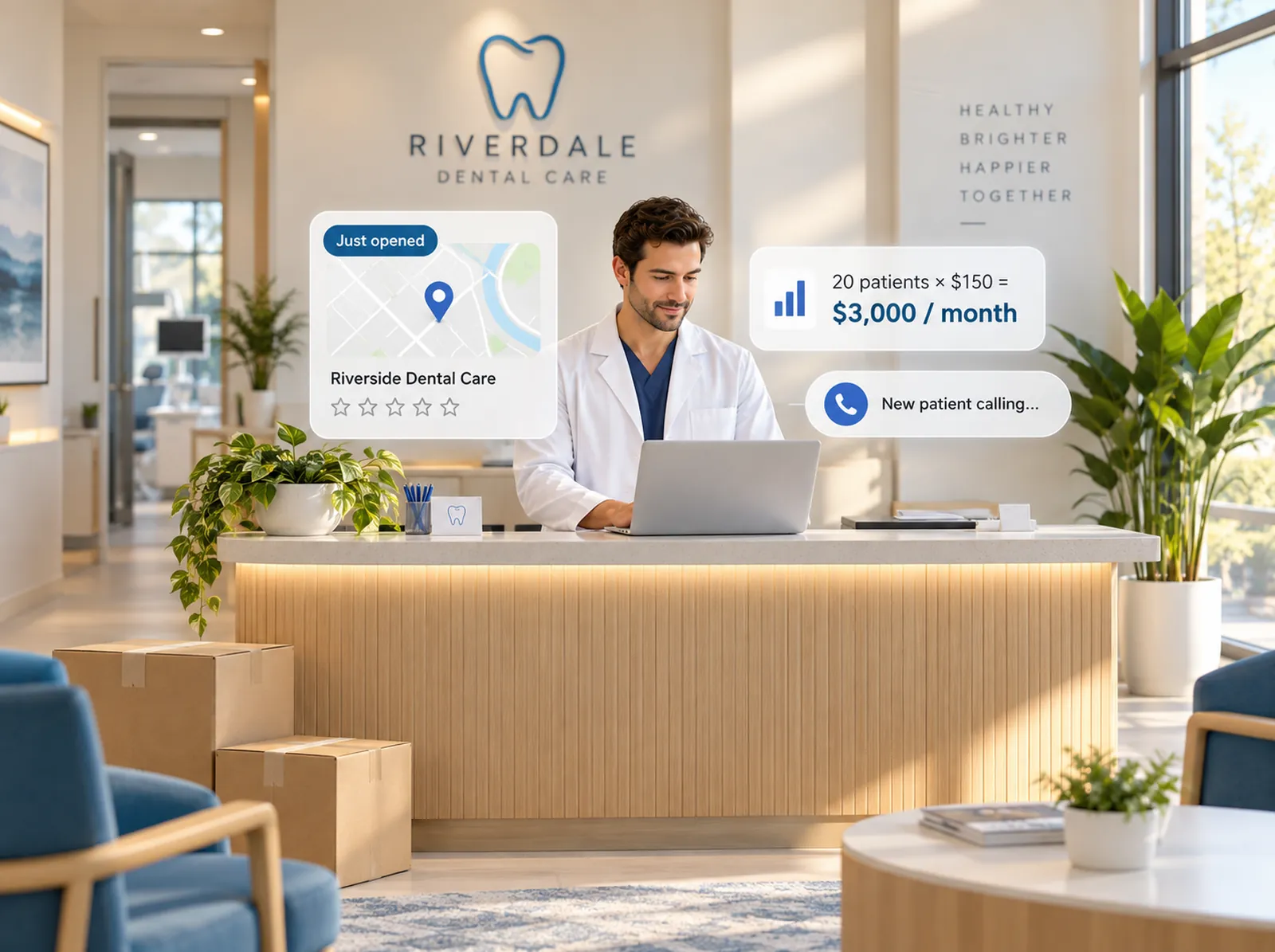
Suppose the target from earlier is another 20 new patients a month. And suppose, after looking at the treatment mix and the economics, the owner decides that spending up to $150 to acquire one new patient makes sense. That produces a working budget of 20 patients times $150, or $3,000 a month.
The point is not the $3,000. It is the way the number was reached. The owner did not start from a vendor's package or a competitor's guess. They started from how many patients the practice needs and what one is worth acquiring. Try it with your own numbers:
Your working marketing budget
Three numbers you already know, or can decide today. Drag to match your practice.
20 patients × $150 each
At your booking rate, about 20 new patients at roughly $146 each. Under your line.
How this is calculated: budget = your monthly target × what you will pay per patient. The benchmark card divides that budget by WordStream's 2026 average cost per dental search lead, $72.97, then applies your booking rate.6 It is a broad national average, not a quote. Replace it with your own cost per inquiry the moment you have one.
And once advertising starts, do not stop measuring at clicks, or even at leads. The real journey runs all the way through the practice:
What ads buy
An inquiry
What the desk makes
A booked appointment
What reminders protect
The patient shows up
What you trained for
The patient gets care
What compounds
They return and refer
If 30 people call and only five book, more advertising buys more calls that go nowhere. Fix the conversion problem first. It is almost always cheaper than buying more traffic.
What's different in 2026: patients ask AI, and AI can work for you
Everything above would have been true ten years ago. Two things are genuinely new, and both favor a practice that is just starting.
First, patients now ask AI. Alongside Google, they put questions like “which dentist near me should I see for a crown” to ChatGPT and Gemini. We analyzed 1,140 of those answers: a typical one names five or six practices, and asking again minutes later brings back only two of them.7 The names churn constantly, and that is good news for you: there is no entrenched ranking to climb. What the AI reads is the same foundation this article started with: a complete profile, real reviews, a clear website. To see where you stand, run our free AI visibility check; the report comes to you.
Second, AI can now do the marketing grunt work for you. Service pages, review replies, reminders, follow-up on missed calls: cheap tools handle all of it, mostly for $50 to a few hundred dollars a month. Two rules keep it safe: a human approves anything patient-facing, and patient information never goes into a consumer AI tool.
What we would want in place before spending aggressively
The goal for a new practice is not every possible marketing channel running. It is a basic machine that works: a patient nearby can discover the practice, what they find gives them confidence, booking is easy, inquiries become appointments, and good experiences quietly become reviews and referrals.
Once that machine exists, paid marketing stops being confusing, because the owner can finally say three very specific sentences:
01“We have capacity for another 15 patients this month.”
02“A booked patient costs us about $130 from Google Ads.”
03“Seven of every ten inquiries become appointments.”
And that is the real milestone
A marketing budget stops being a guess the day those sentences have numbers in them.
That is a very different position from opening the doors and immediately writing checks to five different marketing vendors.
A new practice does not need to do everything. It needs to get the foundation right, understand how patients are moving through the business, and then spend where it can see the spending working.
Where Glace fits
At Glace, we spend our time on exactly these gaps for independent practices: how patients discover them, what happens when those patients call or try to book, and where growth quietly leaks away.
Be found
Marketing and lead gen
A website and local presence built to answer the questions patients and AI assistants actually ask, and demand generation sized to your new-patient target instead of a package
Answer every inquiry
AI Front Desk
Calls answered in a natural voice day and night, insurance questions handled from your approved information, and every inquiry followed up until it books or clearly declines
Make booking effortless
Online booking
Patients book real appointment slots straight into your PMS from your website and profiles, so interest at 11 PM does not have to survive until morning